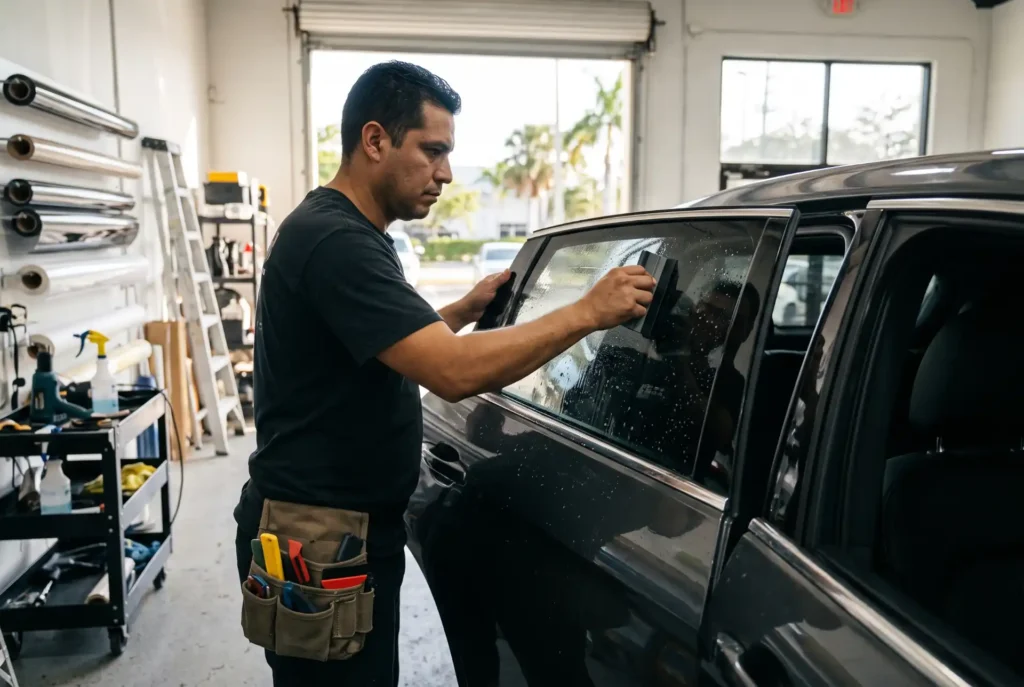
Investing in professional windshield tinting miami drivers rely on has evolved from an aesthetic enhancement into the single most important thermal and dermatological defense for any vehicle in South Florida.
Cruising down US-1 at midday, crossing the Key Biscayne causeway, or idling in gridlock along the Palmetto Expressway exposes your cabin to direct solar radiation that quickly turns vehicle interiors into infrared ovens. Most drivers make the mistake of tinting only the four side doors and the rear glass, completely overlooking that more than 60% of total interior heat gain enters directly through the front windshield.
The front windshield is not only the largest single piece of automotive glass on modern vehicles; it is also installed at an aggressive incline, capturing direct zenith sunlight for hours at a time. Applying high-performance thermal film across this glass requires superior craftsmanship, strict knowledge of Florida statutes, and specialized installation protocols to protect delicate dashboard electronics.
Here is everything you need to know about transparent ceramic film technology, local legal limits, realistic pricing in Miami, and how to protect your investment without drawing unwanted law enforcement attention.
Why Windshield Tinting Miami Is Crucial Against Extreme Heat
The suffocating heat blast you experience when opening your car door in Downtown Miami or Coral Gables cannot be resolved simply by rolling down windows or blasting the air conditioning on maximum. When factory automotive glass lacks an infrared thermal barrier, the cabin suffers from severe radiant heat transfer:
Infrared Radiation (IR): Accounting for roughly 53% of the total solar energy spectrum, infrared waves are directly responsible for scorching steering wheels, burning seatbelts, and pushing leather seat temperatures past 130°F (54°C).
Ultraviolet Radiation (UVA and UVB): While UV rays carry minimal sensible heat, they trigger molecular degradation across plastic trim, dry out dashboard leather, and cause direct cellular skin damage. According to clinical data published by the Skin Cancer Foundation [2], cumulative sun exposure during driving significantly increases precancerous lesions on the left side of the face and arm.
Rake Angle Heat Transfer: Because windshields sit at raked angles between 30 and 60 degrees, they capture overhead solar radiation for the entire day, whereas side windows only receive direct sunlight at specific low sun angles.
Installing advanced thermal film across the windshield halts this incoming energy before it penetrates the cabin, radically boosting air conditioning efficiency.
The Clear Tint Breakthrough: Maximum Heat Defense Without Dark Glass
The most persistent myth among Florida drivers is that a window film must be dark to block heat. This misconception comes from outdated dyed films of the past. Modern optical physics and nanotechnology have completely changed how heat rejection works.
Microscopic nano-ceramic particles do not rely on visible darkness to deflect thermal energy. A tier-one nano-ceramic film rated at 70% or 80% VLT (Visible Light Transmission) is virtually clear to both the naked human eye and law enforcement light meters. However, its molecular structure selectively refracts near-infrared wavelengths.
By installing a high-VLT ceramic film on your windshield, you preserve complete optical clarity for daytime and nighttime driving, maintain pristine road visibility, and reject over 85% of incoming infrared heat. Your steering wheel stays cool to the touch, the dashboard stops radiating heat, and your AC compressor runs at a fraction of its normal load—saving fuel on combustion engines and preserving battery range on electric vehicles.
Florida Window Tint Laws and the AS-1 Line
Florida traffic regulations are designed to keep the driver’s forward sightline clear. Florida Statute Section 316.2952 directly governs materials applied to front windshields:
The Upper Visor Strip: Florida law authorizes a non-reflective tinted strip along the top edge of the windshield, ending above the factory AS-1 line [1]. This line is etched into the glass by the automaker roughly 4 to 6 inches below the roofline. If your vehicle lacks a visible AS-1 stamp, state regulations restrict visor strips to the top 5 inches measured vertically downward.
The Primary Viewing Area: Applying visibly dark films (such as 20%, 35%, or 50% VLT) that obstruct forward vision below the AS-1 line constitutes an equipment violation under state law [1].
Why 70% to 80% Nano-Ceramic Film Leads the Market: Because ultra-clear ceramic films do not darken the glass or alter traffic signal color perception, thousands of South Florida drivers install them across the entire front windshield. They preserve an OEM factory glass appearance that draws zero suspicion from patrol officers while providing world-class thermal rejection.
ADAS Cameras, Dashboard Electronics, and Installation Safety
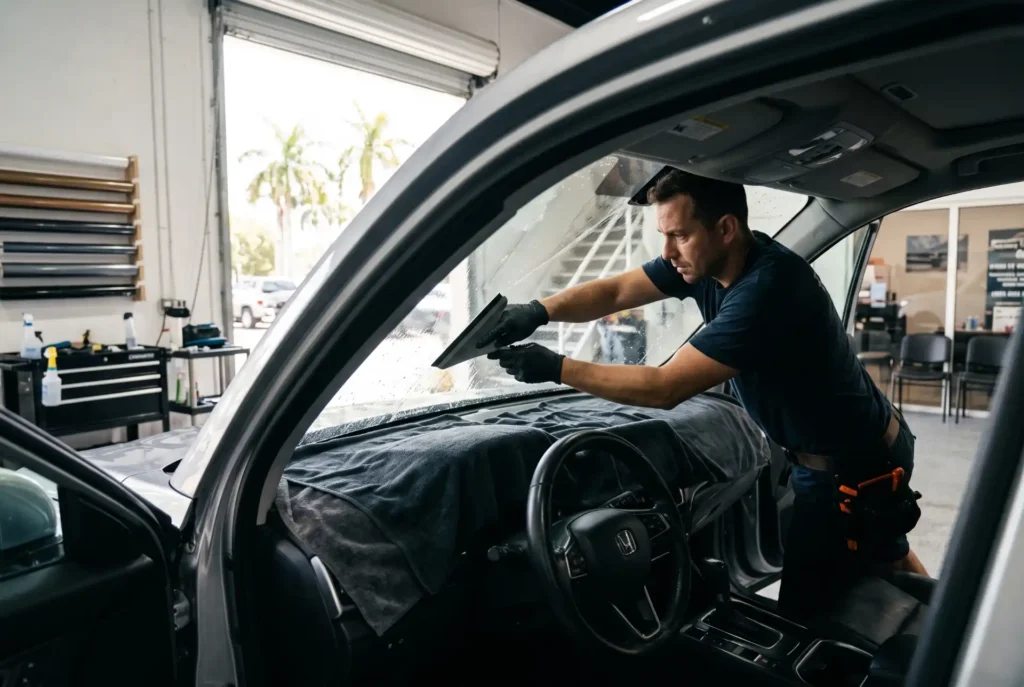
Tinting a side door is standard procedure; tinting a front windshield is vehicular surgery. In vehicles built over the last decade, the area surrounding the rearview mirror houses forward-facing cameras, rain sensors, automated emergency braking systems, and Advanced Driver Assistance Systems (ADAS).
Furthermore, modern vehicle dashboards sit directly above sensitive Body Control Modules (BCM), main electrical harnesses, and fuse blocks. When inexperienced installers spray soapy slip solution across the interior windshield, water runoff can seep into the dash cavity, causing catastrophic short circuits.
Certified studios enforce non-negotiable safety standards:
Soak Rope Protection: Thick, braided absorbent soak ropes are placed tightly along the base where the glass meets the dash to trap every drop of moisture before it reaches vehicle computers.
Exterior Dry Heat-Forming: All heat-shrinking is executed exclusively on the outside face of the glass to avoid overheating interior headliners and sensors.
Precision ADAS Clearances: Specialized plotting software cuts exact perimeters around camera housings and sensor arrays to ensure factory collision-prevention features operate uninhibited.
Dielectric Materials: 100% metal-free nano-ceramic films guarantee complete signal transparency for SunPass transponders, GPS navigation, and 5G cellular connectivity.
Technical Comparison: Roadside Installers vs. Studio Standards
| Operating Standard | Budget Roadside Installer | Blackout Window Tinting Miami |
| Moisture Containment | None; slip solution drips behind the dash. | Mandatory soak ropes and electrostatic dashboard shields. |
| Film Formulation | Cheap dyed polyester or basic carbon. | Pure nano-ceramic rejecting over 85% infrared heat. |
| Film Cutting Method | Hand-cut with razor blades directly on glass. | Digital computerized plotting tailored to your chassis. |
| Nighttime Optical Clarity | Visual distortion, milky haze, and headlight glare. | High-definition optical clarity free of aberrations. |
| Wireless Transmissions | Metallic layers disrupt SunPass and GPS reception. | 100% non-conductive dielectric construction. |
| Warranty Protection | Verbal promises; no coverage for peeling or bubbles. | Written lifetime warranty against failure and bubbling. |
Realistic Windshield Tinting Miami Costs and Material Tiers
Pricing for front windshield installation across Miami-Dade depends on vehicle size, glass curvature, and film technology:
Basic Carbon Film: Typically ranges from 100 and 150. Not recommended for windshields due to lower infrared heat rejection and subtle nighttime optical haze.
Standard Ceramic Film: Generally costs between 150 and 220. Delivers roughly 65% to 75% infrared heat rejection, high UV filtration, and neutral optical clarity.
Premium High-Performance Nano-Ceramic: Ranges between 220 and 320. The premier choice for South Florida heat, deflecting up to 95% of infrared radiation while keeping dashboard surfaces cool.
Beware of shops offering full windshield installations below $80. Rushed heat-shrinking creates optical waves that cause driver eye strain, and careless trimming can permanently scratch OEM acoustic glass.
(Pro Tip: Many performance vehicle owners pair front windshield thermal defense with our complete ceramic window tinting packages for side and rear glass, alongside our exterior ceramic coating to preserve clear coat gloss.)
Frequently Asked Questions About Windshield Tinting Miami
Does clear ceramic windshield tint impair nighttime visibility?
No. High-grade optical ceramic films (70% or 80% VLT) are engineered to maintain visible light transmission identical to factory untinted glass. In fact, they improve nighttime driving comfort by softening glare from oncoming LED headlights and high beams.
How soon can I reattach my SunPass transponder?
Wait at least 48 to 72 hours after installation. This allows all residual mounting moisture to evaporate and ensures the mounting adhesive cures fully. Once cured, you can safely apply SunPass transponders, parking permits, and phone mounts.
Will the film interfere with automatic emergency braking and ADAS cameras?
No. Professional installers use precision computer-cut patterns that stop cleanly around the sensor bracket. The film never covers optical camera lenses, allowing adaptive cruise control and lane-keep systems to function normally.
How long does a full windshield installation take?
A meticulous installation—including glass decontamination, exterior dry shrinking, dash protection prep, and controlled interior installation—takes between 60 and 90 minutes. Avoid quick-turnaround shops that claim to complete full windshields in 15 minutes, as they routinely bypass moisture protection.
Superior Cabin Comfort Without Sacrificing Factory Clarity
The front windshield is the single largest entry point for heat inside your vehicle. Leaving it untreated while tinting side windows is like locking your doors but leaving the front entrance wide open. With advanced nano-ceramic thermal film, you eliminate cabin heat soak, protect expensive dashboard leather from warping, and guard your skin against daily UV exposure.
At Blackout Window Tinting Miami, we utilize precision computerized plotting, clean-room environments, and dedicated electronics protection protocols to deliver flawless, lifetime-warranted installations.
Legal Disclaimer: The information provided in this guide is for educational and technical informational purposes regarding solar control films available in Florida. Blackout Window Tinting advises clients on optical and thermal properties; ultimate shade selection and adherence to local motor vehicle statutes remains the responsibility of the vehicle owner.
Ready to experience a truly cool cabin under the Miami sun? Reach out to Blackout Window Tinting Miami on WhatsApp to schedule your professional nano-ceramic windshield installation today: