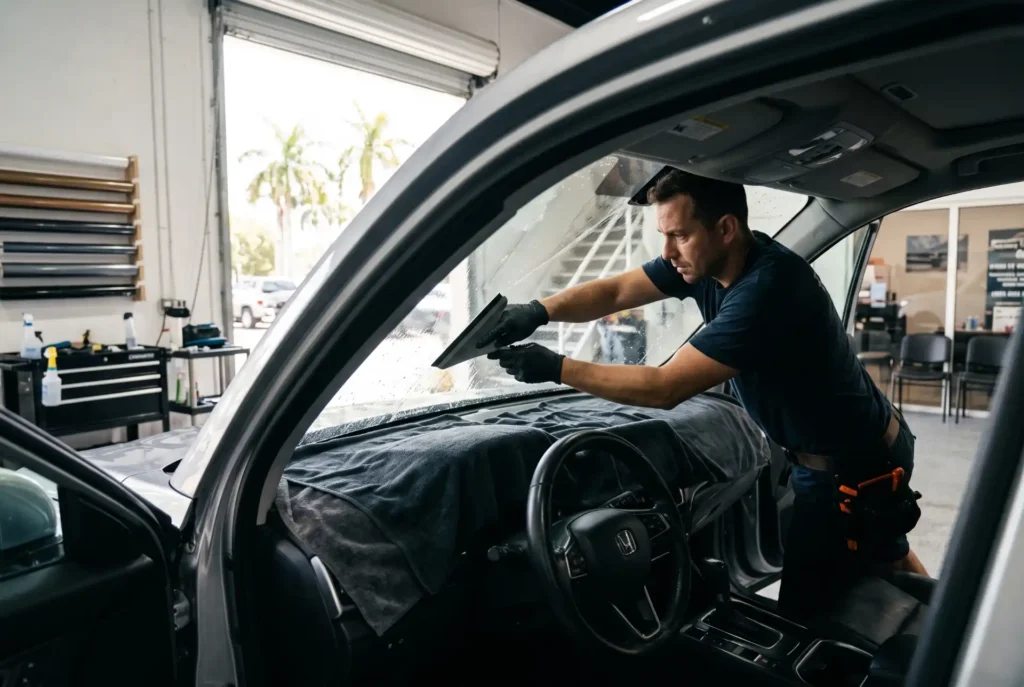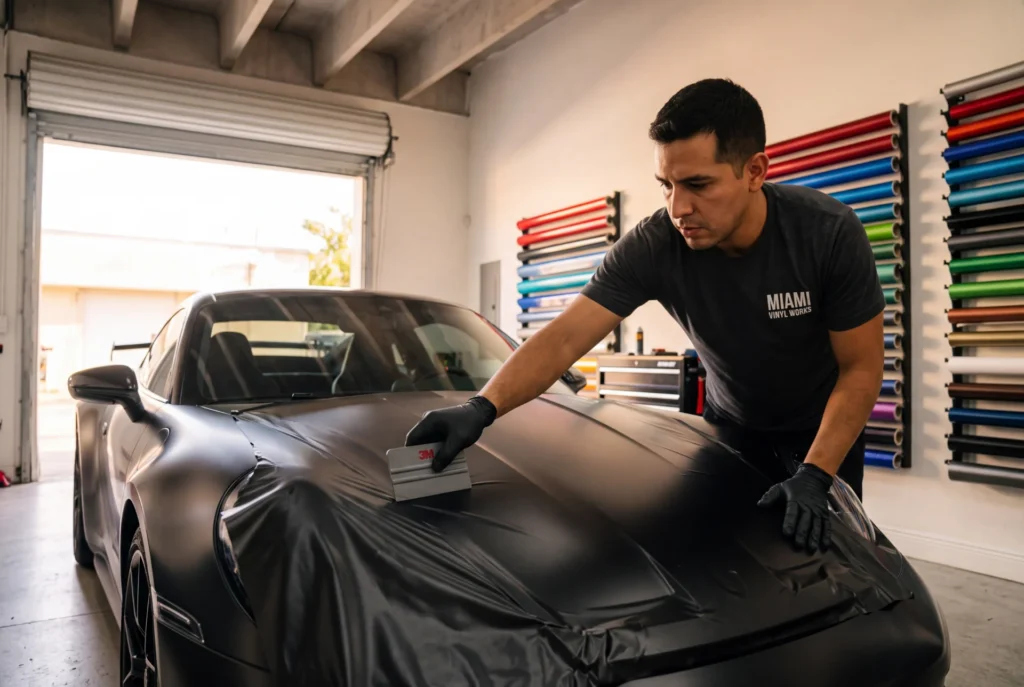
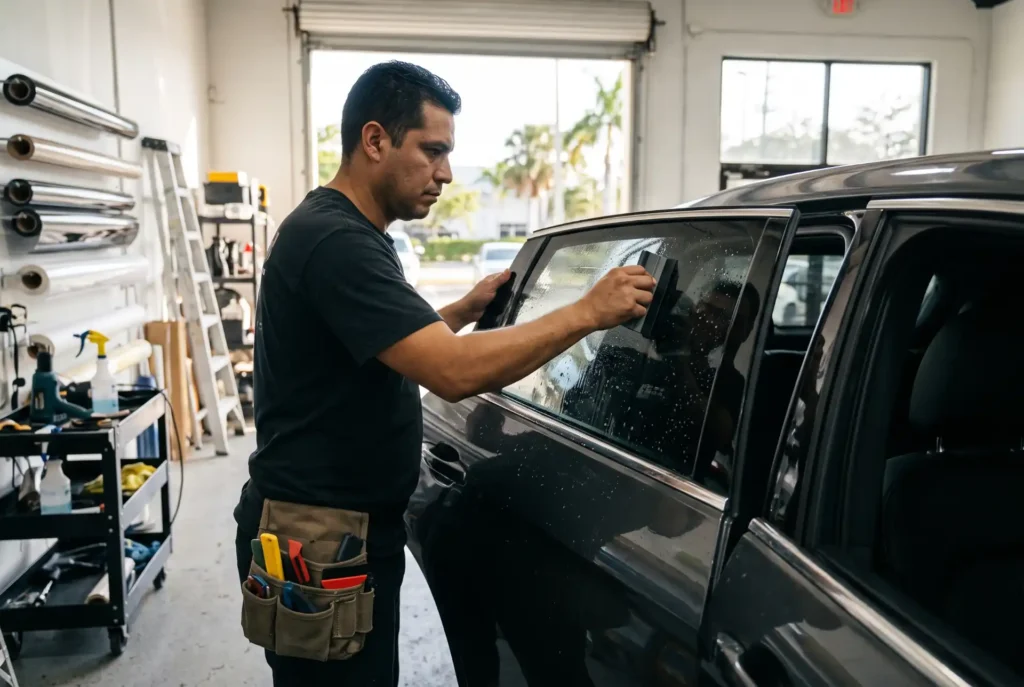
Navigating Florida window tint laws is essential for drivers across Miami-Dade, Broward, and Palm Beach. Cruising down Biscayne Boulevard, the Palmetto Expressway, or the I-95 under South Florida’s blistering sun turns window film into an indispensable thermal survival tool. However, crossing the legal boundary invites immediate traffic stops from the Florida Highway Patrol (FHP) and local police, and can even jeopardize your insurance coverage following an accident.
Unlike what many drivers assume when leaving a dealership or an uncertified tint shop, Florida does not evaluate window film by brand name or subjective shade darkness.
State law measures legality strictly by Visible Light Transmission (VLT)—the exact percentage of light that passes through both the factory glass and the applied film.
Here is the definitive legal and technical guide to Florida’s current tint statutes, vehicle classifications, financial penalties, and how to maximize cabin heat rejection without getting pulled over.
Florida Window Tint Laws: Official VLT Limits and Statutes
Automotive window tinting in the Sunshine State is strictly codified under Florida Statutes Sections 316.2951 through 316.2956 [1]. The law sets exact photometric thresholds for the combined glass-and-film assembly:
| Window Location | Passenger Cars (Sedans & Coupes) | Multi-Purpose Vehicles (SUVs, Trucks, Vans) |
| Windshield | AS-1 line (or top 5 inches) non-reflective [1] | AS-1 line (or top 5 inches) non-reflective [1] |
| Front Side Windows | Minimum 28% VLT | Minimum 28% VLT |
| Rear Side Windows | Minimum 15% VLT | Minimum 6% VLT |
| Rear Windshield | Minimum 15% VLT | Minimum 6% VLT |
The most frequent mistake Miami drivers make is assuming all passenger vehicles follow the same rules. The state separates regulations based on whether your vehicle’s registration classifies it as a conventional passenger car or a multi-purpose passenger vehicle (MPV).
1. Passenger Cars (Sedans, Coupes, and Station Wagons)
Under F.S. 316.2953 and F.S. 316.2954, passenger sedans and coupes face strict rear limits:
Front Side Windows: Must allow at least 28% of visible light to enter (28% VLT). Any film measuring darker is illegal on public roads.
Rear Side Windows: Must maintain a minimum of 15% VLT. Installing 5% limo tint on the rear doors of a sedan directly violates state statute.
Rear Windshield: Requires a minimum of 15% VLT, alongside dual outside side mirrors capable of reflecting a view of at least 200 feet behind the car.
2. Multi-Purpose Passenger Vehicles (SUVs, Crossovers, Pickups, and Minivans)
Trucks and family utility vehicles are granted significantly more privacy behind the driver’s seat:
Front Side Windows: Must adhere to the same non-negotiable 28% VLT requirement.
Rear Side Windows & Rear Glass: State law permits deep privacy film down to 6% VLT, provided the vehicle is equipped with fully operational dual side-view mirrors.
Front Windshield Regulations and the AS-1 Line
The front windshield is the most scrutinized piece of automotive glass across South Florida. Under F.S. 316.2952, applying dark window film across the entire front windshield is strictly illegal [1].
Florida law only permits a non-reflective tint strip at the top of the windshield, ending above the manufacturer-stamped AS-1 line [1]. This line is engraved directly into the glass roughly 4 to 6 inches below the roofline. If your windshield lacks a visible AS-1 stamp, state regulations restrict tint strips to the top 5 inches measured from the upper edge of the glass.
The Smart Engineering Solution: Clear Nano-Ceramic Windshield Film
An increasing number of luxury and exotic car owners in Miami opt for high-transparency nano-ceramic films (such as 70% to 80% VLT) installed across the full windshield.
While strict statutory interpretation restricts added films below the AS-1 line, high-grade ceramic films remain visually indistinguishable from untreated glass. They do not impede night driving or distort light, yet they reject up to 85% of incoming solar infrared heat, preventing the dashboard and steering wheel from baking.
Florida Window Tint Laws on Reflectivity and Prohibited Colors
State law does not stop at measuring tint darkness; F.S. 316.2953 also limits the reflective, mirror-like finish of automotive films:
Front Side Reflectivity: Film installed on the driver and front passenger windows must not exceed 25% solar reflectance.
Rear Side Reflectivity: Rear side glass permits up to 35% solar reflectance.
Prohibited Colors: Florida law strictly outlaws reflective film in red, amber, or yellow. Permitted automotive tones are restricted to neutral charcoal, smoke, bronze, and non-specular black.
Technical Standards: Roadside Installers vs. Certified Studios
Relying on mobile tint installers lacking calibrated photometric meters frequently leads to costly citations and bubbling glass. Here is how low-cost work compares to certified studio standards:
| Technical & Legal Feature | Low-Cost / Uncertified Installer | Blackout Window Tinting Miami |
| Pre-Installation VLT Check | None; estimates darkness by eye on raw film. | Precision two-piece digital VLT light meter testing glass + film. |
| Florida Legal Compliance | High risk of dropping below the 28% front limit. | Certified tolerances guaranteed to satisfy F.S. 316.2953. |
| Material Construction | Low-grade dyed films containing organic pigments. | Multi-layer nano-ceramic rejecting 99% UV and 80%+ infrared heat. |
| Florida Sun Resistance | Fades to purple and blisters within 12 to 18 months. | Molecularly stable; zero fading, hazing, or off-gassing. |
| Wireless Signals | Metallic particles interfere with GPS, 5G, and SunPass. | 100% metal-free; seamless signal connectivity. |
| Warranty Backing | Verbal promises without formal written coverage. | Written lifetime nationwide manufacturer warranty. |
(Pro Tip: Many exotic car owners pair street-legal ceramic window tinting with our high-end car wrapping services to protect both factory paint and cabin interiors against Florida heat.)
Fines, Real Costs, and Police Enforcement in Miami-Dade
When local officers or state troopers suspect illegal tint, the traffic stop is straightforward. Patrol units carry handheld, calibrated two-piece optical light meters that slide around a partially rolled-down window to calculate exact visible light transmission.
1. Citation Penalties and Administrative Escalation
Violating tint limits in Florida is classified as a non-criminal moving/equipment infraction. In Miami-Dade County:
The base fine averages around $116.50, factoring in local court processing fees.
Citations often require the owner to strip the non-compliant film and report to a police inspection station to prove compliance.
Ignoring the ticket or refusing to remove the film escalates the infraction into administrative contempt, which can lead to a formal driver’s license suspension by the FLHSMV.
2. Civil Liability in Car Crash Litigation
A major liability risk that drivers overlook involves personal injury litigation. If you are involved in a nighttime accident or a heavy rainstorm collision on the I-95, insurance adjusters and opposing attorneys will investigate your vehicle’s equipment.
If your car is equipped with illegal tint (such as 5% limo tint on the front doors), the insurance carrier can argue contributory negligence, reducing claim payouts or denying coverage altogether on the grounds that your visibility was illegally compromised.
Medical Exemptions in Florida: Legal Requirements
Florida recognizes that drivers diagnosed with severe photosensitivity require medical-grade solar protection. The Florida Department of Highway Safety and Motor Vehicles (FLHSMV) manages an official medical exemption program under F.S. 316.29545.
Qualifying Medical Conditions
Systemic Lupus Erythematosus.
Severe autoimmune photosensitivity.
Ocular or cutaneous albinism.
History of melanoma or aggressive skin cancer.
Xeroderma Pigmentosum.
The Application Process (Form HSMV 83390)
To obtain an exemption that protects you from traffic citations, you must complete the following steps:
Submit Form HSMV 83390: Have your Florida-licensed physician complete and sign the Application for Medical Exemption Sun-Screening.
Vehicle Registration Tie: Medical exemptions are issued directly to the applicant and assigned to a specific vehicle VIN.
Keep the Certificate in the Vehicle: The FLHSMV issues an official exemption certificate that must remain in your glove compartment alongside your registration. Presenting this certificate to law enforcement waives statutory darkness restrictions.
Frequently Asked Questions About Florida Window Tint Laws
Is 5% limo tint legal anywhere in Florida?
Yes, but only on the rear side windows and back windshield of multi-purpose passenger vehicles (SUVs, vans, and pickup trucks). On passenger cars (sedans and coupes), 5% tint is completely illegal on all windows, as the legal rear limit is 15% VLT. On front side windows, 5% tint is strictly illegal on every vehicle class.
How do police officers test window tint darkness in Miami?
Officers place a two-piece magnetic light meter on both sides of your driver’s window. The unit shoots a calibrated laser beam through the glass, displaying the exact combined VLT percentage instantly. If the reading falls below 28% after accounting for standard equipment tolerance, a ticket is issued.
Does Florida require a certification sticker between the glass and film?
Under F.S. 316.2955, manufacturers and installers are legally required to sell compliant materials, but Florida drivers are not required to display an exterior certification sticker on their glass. However, certified shops will provide a formal invoice documenting your film’s technical VLT specifications.
Can you legally tint headlights or taillights in Miami?
No. Florida Statute F.S. 316.234 explicitly prohibits smoked covers, dark films, or spray coatings over automotive headlights and brake lights. All exterior lighting must project standard, unobstructed visibility from a distance of at least 1,000 feet.
Maximize Heat Defense Without Legal Hassles
South Florida’s subtropical climate demands high-performance solar protection to preserve your skin, prevent leather dash cracking, and ease air conditioning strain. However, installing illegal, low-grade film carries fines, inspection hassles, and insurance liabilities that far outweigh any upfront savings.
Modern nano-ceramic technology allows you to block 99% of UV radiation and over 80% of infrared heat while staying fully compliant with the 28% front and 15% rear thresholds enforced across Miami-Dade.
Want to confirm if your vehicle is street-legal or upgrade to certified, lifetime-warranted ceramic tint? Reach out to Blackout Window Tinting Miami on WhatsApp to schedule a complimentary digital VLT light meter inspection with our master technicians: