Investing in professional ppf miami drivers rely on represents the definitive upgrade for anyone looking to shield their vehicle’s bodywork against the brutal road conditions and climate of South Florida.
Commuting daily along the Palmetto Expressway (SR 826), Interstate 95, or Florida’s Turnpike subjects factory paint to an unrelenting blast of loose gravel, coastal sand, and fragmented asphalt kicked up by heavy commercial haulers at speeds exceeding 70 mph. A single direct impact on the front bumper or hood easily punctures factory clear coat, leaving raw metal vulnerable to accelerated corrosion fueled by intense ocean humidity and Atlantic salt air.
While many car enthusiasts mistake paint protection film for synthetic wax or liquid ceramic coatings, the underlying engineering belongs to a completely different class. High-grade film is a military-grade, elastomeric ballistic shield developed to absorb violent mechanical kinetic energy.
Here is a comprehensive breakdown of self-healing polymer technology, realistic studio pricing in Miami, and why precision installation with wrapped edges is essential for preserving your vehicle’s resale value.
Why PPF Miami Is the Ultimate Defense for Florida Highways
Road conditions across Miami-Dade County combine three severe hazards that degrade factory finishes faster than almost any other region in the country:
Relentless Construction Debris: Ongoing development across Downtown Miami, Brickell, and Doral brings a continuous influx of industrial gravel haulers. The massive rear tires of these trucks fling road stones at highway velocity, turning them into high-speed projectiles aimed directly at your vehicle’s front fascia.
Corrosive Seasonal Lovebugs: During Florida’s mating seasons, swarms of lovebugs blanket highway lanes. The biological fluids inside these insects contain concentrated organic acids. When combined with engine operating temperatures and blazing sunlight, these acids burn into untreated clear coat in fewer than 48 hours unless blocked by an elastomeric urethane barrier.
Intense UV Exposure and Thermal Stress: Summer UV index ratings across South Florida routinely exceed level 10. Unfiltered solar radiation oxidizes clear coats, causing pigments to fade and clear coat layers to turn brittle, making the surface far more prone to chipping from minor abrasions.
The Physics of Protection: Why Ceramic Coatings Do Not Stop Rock Chips
One of the costliest misconceptions among sports car and luxury SUV owners in Florida is assuming that a ceramic coating will prevent highway rock chips. Understanding the physical scale of both products makes the difference clear:
Ceramic Coating: A liquid silicon dioxide (SiO2) resin that chemically cures over microscopic clear coat valleys. Its cured thickness measures between 1 and 2 microns—roughly one-fiftieth the thickness of a human hair. While it provides incredible hydrophobicity, chemical stain resistance, and mirror gloss, it possesses zero elastic mass. A hard stone striking your bumper at 70 mph shatters through the glass layer instantly.
Paint Protection Film (PPF / Clear Bra): A solid high-density Thermoplastic Polyurethane (TPU) membrane measuring approximately 8 mils (~200 microns) thick. Its high-tensile molecular matrix functions like a ballistic cushion: it absorbs the projectile’s kinetic energy, disperses the force across the membrane, and rebounds without allowing the stone to reach factory paint.
These two technologies are complementary rather than competing. The modern automotive detailing gold standard involves installing protective film across high-impact exterior panels (such as the full front end), then layering a professional hydrophobic ceramic coating over the entire vehicle—including on top of the film—to make regular maintenance effortless.
Molecular Self-Healing Under the Miami Sun
The standout feature of cutting-edge thermoplastic polyurethane is its ability to self-repair surface damage without mechanical buffing. Premium clear bra films from industry-leading manufacturers utilize an advanced elastomeric topcoat engineered with thermal shape memory.
When the film sustains wash-induced swirl marks, minor branch scrapes, or road grit abrasion, the polymer chains do not sever; they temporarily shift out of alignment.
When exposed to natural heat from the Miami sun (panel temperatures over 90°F / 32°C) or rinsed with warm water, the polymer matrix relaxes and flows back into its original flat orientation. Surface scratches literally vanish on their own within minutes.
Coverage Packages: Tailoring Protection to Your Vehicle
Not every build demands a full-body wrap. When exploring ppf miami options, reputable restyling studios categorize coverage into targeted tiers based on how you drive:
Front Bumper Only: Covers the plastic front fascia. An entry-level package for urban drivers looking to avoid low-speed parking scrapes and minor road rash.
Partial Front (Track Pack): Protects the front bumper, the leading edge of the hood (roughly 18 to 24 inches), the front portion of the fenders, and side mirror caps.
Full Front Coverage: The most popular and highly recommended package in South Florida. Covers 100% of the hood (eliminating visible seam lines), both complete front fenders, the front bumper, headlights, and side mirror housings. This package shields panels that absorb over 90% of highway impacts.
Full Body Wrap: Encloses every painted panel on the vehicle, including doors, roof, rear quarter panels, trunk, and side skirts. Essential for exotic supercars (Porsche, Ferrari, Lamborghini), vehicles with delicate factory matte or satin finishes (Frozen paint), or off-road trucks.
Certified PPF Miami Studios vs. Roadside Installers
The durability, appearance, and longevity of clear bra depend equally on raw material quality and installer craftsmanship:
| Installation Criteria | Low-Cost / Uncertified Shop | Blackout Window Tinting Miami |
| Material Base | Low-grade PVC or TPH; yellows and hazes within 12 months. | High-grade Aliphatic TPU with full UV stabilization. |
| Cutting Method | Hand-cut with razor blades directly on painted panels. | Computerized precision digital plot patterns mapped to your VIN. |
| Edge Finish | Exposed edges stopping short of panel borders, gathering black dirt. | Tucked and wrapped edges hidden cleanly behind panel gaps. |
| Self-Healing Ability | Minimal or non-existent; requires rotary polishing. | Instant thermal self-healing activated by direct sunlight. |
| Film Removal | Leaves hardened adhesive residue and risks pulling clear coat. | Clean steam removal leaving factory paint in mint OEM condition. |
| Warranty Backing | Verbal promises; excludes yellowing and adhesive failure. | 10-year manufacturer warranty against cracking, bubbling, and yellowing. |
(Pro Tip: Many luxury and exotic vehicle owners complete their build protection by pairing clear bra with our high-heat rejection ceramic window tinting to keep the cabin cool, or choosing a color-change car wrapping transformation to restyle the exterior prior to clear PPF installation.)
Realistic Paint Protection Film Installation Costs in Miami
Professional film installation pricing reflects the premium cost of raw aliphatic polyurethane rolls, specialized clean-room facility overhead, and the intensive technical labor required:
Front Bumper Only: Typically ranges from $600 to $900.
Full Front Package: Generally costs between $1,800 and $2,600 (enclosing complete hood, full fenders, front bumper, headlights, and mirrors).
High-Impact Track Package (Full Front + Rocker Panels + A-Pillars): Averages between $2,800 and $3,800
Full Body Coverage: Ranges from $5,000 to $7,500+
depending on vehicle scale (compact coupe, full-size SUV, or exotic hypercar).
Key factors that influence your final estimate:
Paint Correction Requirements: Urethane film is optically clear, meaning it seals in whatever paint condition lies beneath. Vehicles showing swirl marks, oxidation, or dealer buffer trails require a multi-stage machine polish before installation.
Chassis Curvatures and Aero Packages: Complex aerodynamic splitters, aggressive front diffusers, and deep hood recesses require custom panel manipulation and additional labor hours.
Frequently Asked Questions About PPF Miami
Does paint protection film turn yellow under constant Florida sun?
No, provided you choose modern aliphatic thermoplastic polyurethane. Early-generation films from decades past used aromatic urethane or PVC formulations that degraded under UV exposure. Tier-one films feature aerospace-grade UV inhibitors that prevent yellowing, hazing, and cracking for 10 or more years.
Can I run my vehicle through an automatic car wash with PPF installed?
We strongly advise against automatic brush car washes. Spinning abrasive nylon brushes can catch the seams of the film or grind dirt into the surface. Instead, practice hand washing using the two-bucket method or use touchless automated washes. When using a pressure washer, keep the spray nozzle at least 18 inches away from panel edges.
Can the film be removed in the future without damaging OEM paint?
Yes. Quality automotive films feature semi-permanent acrylic adhesives engineered for clean removal. Using controlled commercial steam, technicians lift the film off in continuous sheets without leaving adhesive residue or lifting factory clear coat. The underlying paint remains in the exact condition it was in on installation day.
How long does the installation process take?
A standard Full Front package takes between 2 and 3 business days, accounting for multi-stage decontamination washes, paint correction, installation, and a mandatory 24-hour drying period to inspect edges. Complete full-body installations generally take 5 to 7 business days.
Protect Your Factory Clear Coat and Secure Resale Value
In South Florida’s competitive luxury automotive market, original paint condition directly influences trade-in and resale value by thousands of dollars. Repainting a damaged hood or bumper rarely duplicates factory robotic paint thickness or texture, and aftermarket resprays are immediately detected by digital mil gauges during dealer trade-in inspections.
Choosing premium ppf miami installations safeguards your original factory finish, providing the only mechanical shield capable of absorbing heavy impacts along Interstate 95 while maintaining flawless, self-healing gloss.
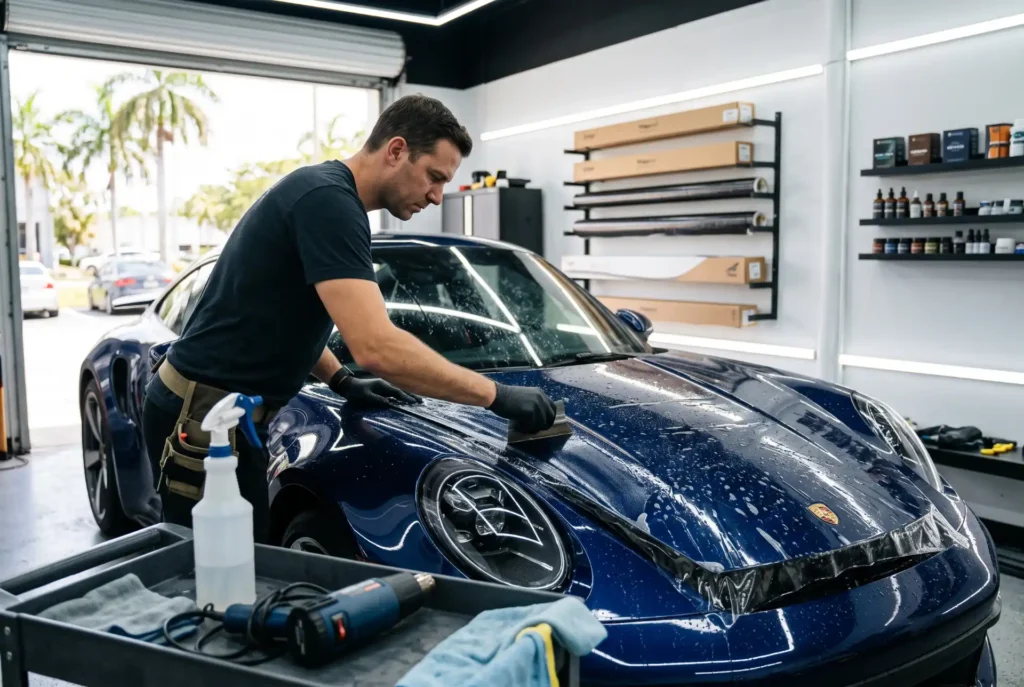
At Blackout Window Tinting Miami, we utilize precision computerized plotting software, climate-controlled clean rooms, and certified master installers to deliver tucked edges and virtually invisible coverage.
Legal Disclaimer: The technical information in this guide is for educational purposes regarding automotive surface protection films and materials in Florida. Blackout Window Tinting evaluates every vehicle’s paint depth and integrity prior to installation; overall film longevity depends on owner adherence to proper wash techniques and preventive care.
Ready to armor your vehicle’s front end before your next highway commute? Reach out to Blackout Window Tinting Miami on WhatsApp to request your personalized quote with a complimentary paint inspection: